Always on: living with a nervous system that won't settle
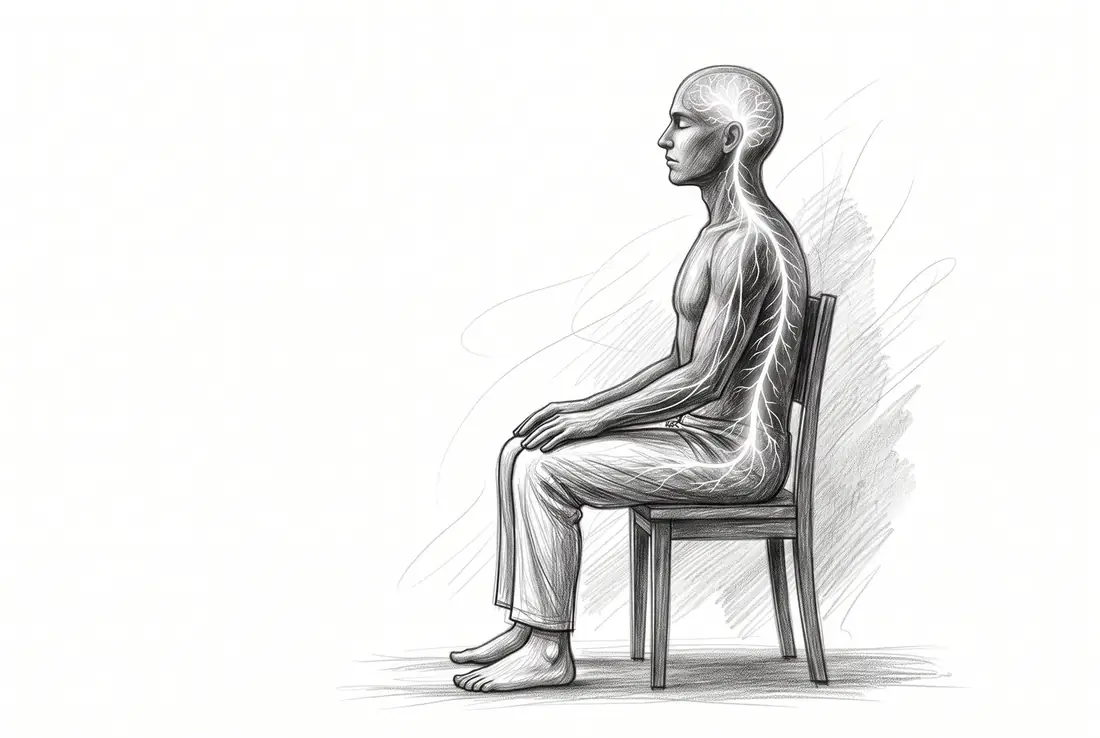
There is tension in my body and my mind is working overtime. That is often how it starts. My nervous system is switched on without anything being wrong, and my thoughts go looking for a reason.
Feeling is the hardest part then. For a long time I didn’t even notice I was moving away from my feelings and emotions. I was in my head, and my body kept running somewhere beneath me. Now I notice it sooner and I know how to come back.
I write this as someone who is still learning about this every day.
Finding the term
When I came across the term GHIA, I finally had a name for what I was feeling. GHIA stands for Global High Intensity Activation and comes from Somatic Experiencing, a body-oriented method for working through stress and trauma. It describes a nervous system that went into survival mode very early in life and never fully came out of it. There is always a high baseline of tension, even when nothing is wrong right now.
It is not a diagnosis. What it mostly gave me was an explanation for something I didn’t understand. Why some forms of therapy were too intense for me, while they seemed to work for others.
Too deep, too fast
A few times I went too deep, too fast. My system would short-circuit completely and get stuck in tension and freeze, the state in which the body stiffens and feeling drops away. What was meant as letting go became a new overwhelm.
That is where I learned to go slowly, in small doses of tension, instead of looking for one big release. In Somatic Experiencing this is called titration. Practising often and gently, in a way that doesn’t push the system into overdrive but gradually gives it more room to simply be.
The intention has to be right too. Am I doing this exercise to get away from a feeling, or to be able to stay with it for a moment? From the outside you can’t see the difference, but on the inside you can feel it.
Staying only works when it isn’t too much (within your window of tolerance). When the emotion or sensation gets too intense, I go back to my thoughts.
How it lives in me
For me the tension sits mostly in my belly and my left shoulder. That is where it contracts.
What I didn’t understand for a long time is that good things can make my system contract too. Growth, visibility, connection. Raja Selvam, one of the teachers within Somatic Experiencing, explains that when stress comes early in life, the body doesn’t distinguish between good and bad activation. It is all more than it is used to.
Social activities can regulate me, but they can also dysregulate me. Time alone can do the same. There is no fixed rule. What I do notice is that safe, attuned contact does something I can’t manage on my own.
What matters is sensing what I need in any given moment. Sometimes that nuance just isn’t there, or not enough. Then my thoughts take over and try to come up with a solution for the feeling.
The searching itself
And because of the tension, it has to go fast. I start searching and analysing. New methods to release stress, new insights, another book, another framework.
It looks like working on myself. Often it is a way of not having to drop into my body. The restlessness keeps me away from it and keeps pulling me back into my head. Sometimes it already helps to know that the tension won’t stay. Then I don’t have to solve anything. I let it be for a moment and simply watch.
Getting to know my system also helps me recognise when to turn to my resources. That can be a walk in nature, a pet, people I love or something creative.
Sometimes it is even simpler. Orienting, which means calmly looking around and letting in where I am. Or feeling the contact of my feet on the floor. That way my body gets the signal that it is safe here.
All of it helps me come out of my head and into the here and now, again and again. Not once and then it’s done. Again and again.
That is where I find rest.
How this shapes my work
Because I know freeze and that high tension so well from the inside, I also recognise them in the people I work with as a somatic therapist. I can acknowledge that state and give it time and space, so someone can settle and discover for themselves what lies beneath the tension.
What I meet there in myself is a very young part, from a time I don’t remember cognitively. My body does remember it.
The way in is the body. Making contact slowly and with empathy with that young, vulnerable part, which back then didn’t get the time or the basic safety to simply process stress and stimulation.
I don’t do this work alone. I have my own guidance and supervision, so I can be clear and present for whoever comes to me.
Again and again
It takes time, courage and empathy for yourself to build that basic safety.
There are still days when my mind works overtime and I only discover later that I wasn’t connected to my body, though there are fewer and fewer of them. Then I start again. Feet on the floor. Looking around. A short walk in nature. And feeling what is there, without having to solve it.
Want to read more about GHIA? Mad in the Netherlands has an in-depth article on it (in Dutch).
Do you recognise yourself in this story? The free Nervous System Scan gives you a clear picture of where your nervous system stands right now, in just a few minutes.
You don’t have to figure this out on your own. Read more about 1:1 sessions.